


Almost every other company these days requires business intelligence tools to stay in the competition. Companies of all sizes and stages need BI tools to make smarter and informed business decisions, manage, and analyze business data. BI tools help in visualizing the reports generated and maximize revenue outcomes.
The primary benefit of business intelligence tools is to provide a solution that is suitable for your business. It customizes and offers a solution that is most suitable to the company and is relevant to your business goals. With business intelligence and business analytics, your company can have an account of all the impacts it has had (whether they’re good or bad.) Data analytics plays a vital role in helping your company devise the best plan possible. Business intelligence systems help companies move towards the right direction and make smart choices from the business data collected and analyzed.
Business Intelligence (BI) software helps companies to develop new strategies by analyzing the current market trends and say above their competitors. It allows companies to score new opportunities; complete customer satisfaction based on data-driven reports. It helps optimize service for the clients, improves productivity, and monitors all the data from anywhere in real-time.
Benefits of Business Intelligence Tools
The benefits of business intelligence tools are plentiful. The most advantageous of them are:
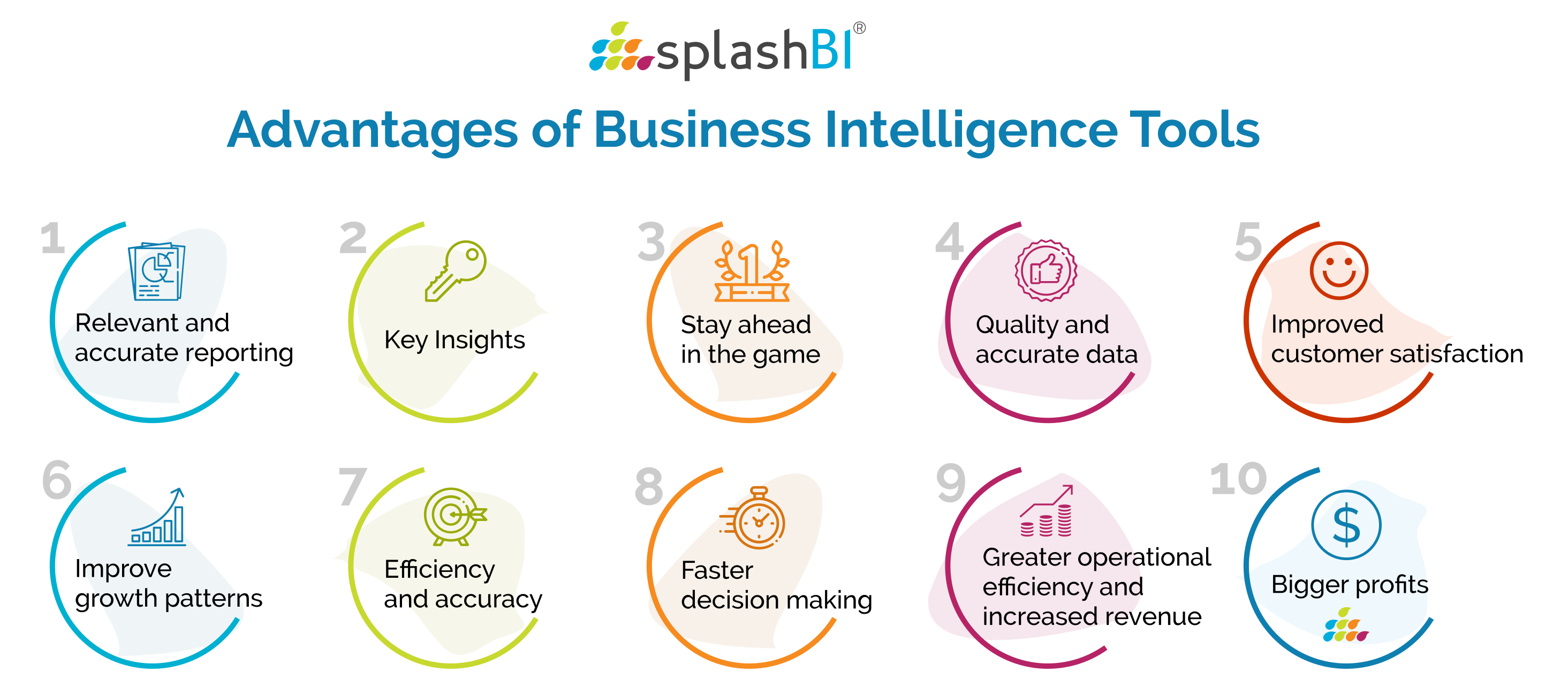
1. Relevant and accurate reporting:
Using different kinds of data sources, employees can customize their reports and monitor KPIs. Real-time generated reports offer the most pertinent data, which help companies make faster and better decisions. Data from sales, finance, or operations are used to create easily accessible reports, have great visualizations with the help of charts, graphs, tables, etc. These reports offer faster insights, access, accuracy, and relevancy.
2. Key Insights:
BI reporting tools assist in monitoring. To get the complete insight on revenue, losses, gains, the productivity of the employees, performances of the employees (individual and team-based.) It provides valuable information about the positives and the negatives. With these tools, companies can easily track the metrics and be current with what’s happening and what’s to come by setting up alerts, getting real-time information on the KPIs, and alerting any pitfalls that otherwise could have gone unnoticed.
3. Stay ahead in the game:
Companies of all sizes have vast amounts of data. Moreover, managing and using data for business decisions provides a competitive edge. BI offers incredible benefits with the help of this data in terms of forecasting, budgeting, planning, and staying on top of things via analysis. Competitive analysis helps companies to know the competition and the performance of their competitors as well. This, in turn, leads to finding out how to differentiate one’s products from others. It goes the same for services as well.
4. Quality and accurate data:
The success of any kind within an enterprise is data-dependent. Quality of data defines the quality of the company and its success. Any inaccuracies or flaws in the data can turn businesses upside down. BI tools help businesses in cleaning up data, creating data of high quality, collecting, updating, and analyzing data to gain the most relevant insight on what’s going on within the company.
5. Improved customer satisfaction:
Business intelligence software mainly helps companies to not just learn about their employees but their customers too. When it comes to customer behavior, user personas, feedback, BI lets you in on all the insights. These BI tools help to identify what’s lacking with your services or products and enhance customer satisfaction by making necessary changes. Real-time data on the customer’s feedback help in bringing corrective changes and deliver excellent customer service and satisfaction.
6. Improve growth patterns:
BI assists companies in gaining a competitive edge by helping them find new opportunities and build smarter strategies. With the help of all the data, you can identify market trends and help improve profit margins for the company. New sales trends can be identified by leveraging data from the internal and external markets, analyzing the data. The market conditions can help spot any business issues that can otherwise go unnoticed.
7. Efficiency and accuracy:
BI tools offer a single source of information; it helps the employees or the executive hierarchy to spend more time on productivity and less time on managing data. This way, employees can focus on producing reports and timely deliverables in real-time. This accurate information leads to better decision making and helps companies achieve long and short-term goals.
8. Faster decision making:
BI reduces the times a company has to lose a customer, revenue, or deal with inaccurate information or slow processes. It is essential in gaining a competitive edge for companies to make faster and accurate decisions by leveraging the existing data, at the right time, and improve decision making.
9. Greater operational efficiency and increased revenue:
BI tools offer business data, which makes the leaders and employees of a company think about the decisions made, processes implemented, and strategies executed. Getting a 360-degree view on all the dimensions to help companies identify issues and improve operations, increased sales, and in turn, increase revenue.
10. Bigger profits:
Most businesses find profit margins as a big concern. BI tools can analyze from the enormous volumes of data any discrepancies, inefficiencies, errors, etc. It helps expand profit margins, and the sales teams get better insights for future sales and analyze where to spend the budgets in the future.
How is SplashBI Different?
SplashBI helps organizations make business decisions by giving instant access to data from diverse systems in the form of reports, visualizations, & trends. SplashBI is available both on the Cloud and on-premise. SplashBI offers insightful pre-built content, powerful ad-hoc reporting for immediate ROI. Its data models allow for fast-track-low-cost implementations. There is no need to spend hefty amounts on consulting and services to get the Business Intelligence tools your team needs to achieve your competitive advantage.
To Sum Up!
Organizations must make informed decisions to enhance their performance. Business intelligence tools or BI tools have all the necessary accessories to make this happen. The belief that business intelligence tools are available only for large enterprises does not hold anymore. BI is for everyone, be it large or small enterprise.

The SplashBI Editorial team covers enterprise analytics, AI-driven decision-making, and the future of Finance and HR intelligence.
Frequently Asked Questions
How does drill down analysis improve business reporting and decision-making?
Drill-down analysis significantly improves business reporting and decision-making by enabling detailed, transaction-level analysis, which uncovers trends, patterns, and areas for improvement, ultimately leading to more accurate and reliable financial reporting. • Empowers businesses to perform detailed transaction-level analyses. • Helps uncover hidden trends and patterns within data. • Identifies potential areas for improvement by examining underlying transactions. • Facilitates the resolution of current discrepancies and prevention of future issues. • Contributes to more accurate and reliable financial reporting over time. • Enables deeper insights to drive better decision-making.
Why is real-time data access capability crucial for generating actionable analytical reports for executive decision-making?
Real-time data access is crucial for generating actionable analytical reports as it enables executives to make timely, data-driven decisions by utilizing current transactional data from ERP systems, thereby improving business performance and adaptability. • Organizations of all sizes benefit from real-time reporting, allowing them to leverage the full wealth of their data for essential business decisions. • Utilizing real-time, transactional data from existing ERP applications, such as Oracle, is a proven method to enhance business performance. • Modern business demands quick answers to pressing questions, which ad-hoc reporting capabilities powered by real-time data facilitate. • Cloud solutions enable businesses to consolidate data (e.g., payroll, finance), making it easier to extract necessary real-time insights and reports seamlessly and quickly. • The limitations of rigid, non-real-time report formats can significantly impede strategic decision-making in an environment that increasingly requires up-to-the-minute insights.
How does an analytical report fundamentally differ from a standard operational or descriptive report in a B2B context?
Analytical reports fundamentally differ from standard operational or descriptive reports by focusing on deeper insights for strategic decision-making, often integrating data across multiple subject areas, whereas operational reports typically provide real-time, transactional data for day-to-day operations within specific business functions. • Operational reports are generally focused on real-time, transactional data from specific operational systems (e.g., ERP applications) to support immediate, day-to-day business processes. • Analytical reports aim to provide deeper insights by combining data from various subject areas, allowing for comprehensive analysis and understanding of trends, patterns, and root causes. • The creation of cross-subject area operational reports can be highly complex and require extensive technical skills, indicating that standard operational reports are often siloed by their data source or subject. • Analytical reports facilitate data-driven decision-making by leveraging a broader wealth of data to uncover insights that might be missed with purely operational reporting. • While operational reports ensure business continuity and monitor current performance, analytical reports drive strategic planning, forecasting, and continuous improvement.
How do analytical reports help organizations identify trends, patterns, and actionable insights from business data?
Analytical reports transform raw business data into evidence-based, strategic insights by identifying trends, patterns, and historical performance. This enables business leaders to make informed decisions, resolve key issues, and improve overall efficiency and resource utilization. • Analytical reports convert complex business data into evidence-based insights on strengths and weaknesses, helping organizations identify areas of success and those requiring improvement. • They enable businesses to identify problems at an early stage, which might impact growth, allowing for accurate and timely corrective actions. • By extrapolating historical data, analytical reports help predict future problems or market shifts, allowing businesses to take proactive steps. • The insights provided help leaders, including C-suite executives (CHRO, CEO, CFO), make data-driven decisions that ultimately drive better financial outcomes, increase return on assets, and optimize resource utilization.