What AI Changes About BI Work and What It Doesn’t
Beyond The Hype: The Real Impact of AI on BI Workflows
AI is often framed (and feared) as a replacement story. Analysts out. BI teams automated away. Dashboards replaced by prompts.
But inside enterprises, the reality looks very different. Studies show that while AI adoption in analytics is rising sharply, most organizations are using it to augment BI workflows, not eliminate them. BI teams are still very much in place, and demand for analytics continues to grow, not shrink.
What has changed is how the work gets done.
Questions are asked more directly, without long translation cycles. Insights are explored faster, with fewer back-and-forth loops. Outputs are summarized automatically instead of manually narrated. The friction is lower. The standards are not.
This is the real shift. AI redistributes effort in BI work. It reduces mechanical overhead, but it does not replace modeling, definitions, governance, or trust.
So where is the real impact? What is hype, and what actually holds up in production? What is signal, and what is noise? This blog separates real change from wishful thinking.
Where BI Work Used to Get Stuck
For years, much of BI work was consumed by friction rather than insight.
Business questions rarely arrived in a form that analytics systems could handle directly. Analysts spent time translating intent into technical queries, clarifying assumptions, and looping back when the first answer was not quite right. Each question triggered a chain of follow-ups, revisions, and waiting.
Dashboards helped, but they did not eliminate the bottleneck. Business users still waited for reports to be built, adjusted, or explained. Tools were powerful, but access to insight remained gated.
As a result, analysts often acted as interpreters instead of problem-solvers. Their value was tied to navigating tools and translating requests, not to shaping better questions or driving better decisions.
The hard truth is that traditional BI work was less about analysis and more about access and translation. That is the friction AI is now starting to remove.
What AI Actually Changes: Lowering Friction in BI Workflows
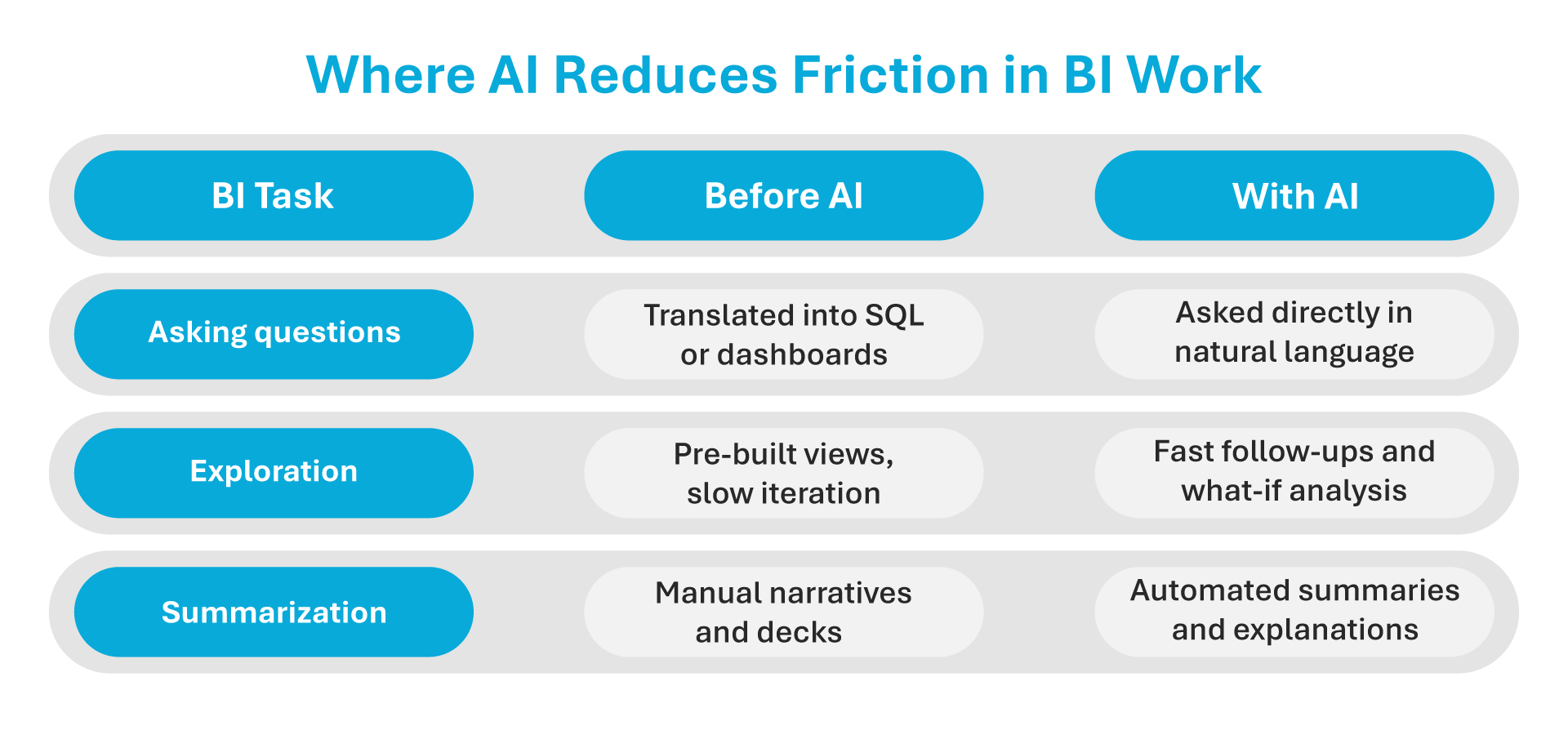
AI’s real impact on BI shows up in very specific places. It does not overhaul the entire discipline. It removes friction from repeatable parts of the workflow.
Questioning: Natural language queries reduce the translation gap between business intent and technical execution. Instead of converting questions into SQL or dashboard logic, users can ask directly. The overhead of interpretation drops. BI teams spend less time decoding what someone meant.
Exploration: AI accelerates iteration. Follow-up questions are faster. What-if paths are easier to pursue. Users no longer need to predefine every view before learning something useful. Exploration becomes continuous rather than staged.
Summarization: AI handles narrative work that used to be manual. Key insights are surfaced automatically. Explanations are generated in plain language instead of assembled after the fact.
For BI teams, this shift is meaningful. Less time goes into mechanics like query writing, chart tweaking, and repetitive explanation. More time is freed for judgment, model design, exception handling, and decision support.
The core insight is simple. AI accelerates workflows. It does not – and should not – replace analyst thinking.
What AI Does Not Change: BI Fundamentals That Still Matter
AI changes how analytics is accessed. It does not change what analytics depends on.
BI fundamentals AI still relies on
- Data models that define structure and relationships
- Metric definitions that ensure consistency across teams
- Governance that controls access and usage
- Trust in the numbers being produced
These are not optional. AI cannot work around them.
What happens without strong foundations
- Confident but incorrect answers
- Conflicting outputs to the same question
- Rapid loss of trust in AI-driven insights
AI does not fail quietly when fundamentals are weak. It fails loudly.
Why BI teams are still essential
- Designing and maintaining data models
- Enforcing metric consistency as the business evolves
- Protecting trust as users and data sources scale
The core insight is simple and often missed.
Where BI discipline is strong, AI accelerates value. Where it is weak, AI exposes the gaps faster than any dashboard ever did.
How BI Work Is Shifting, Not Shrinking
AI is not reducing the amount of BI work. It is changing where effort goes.
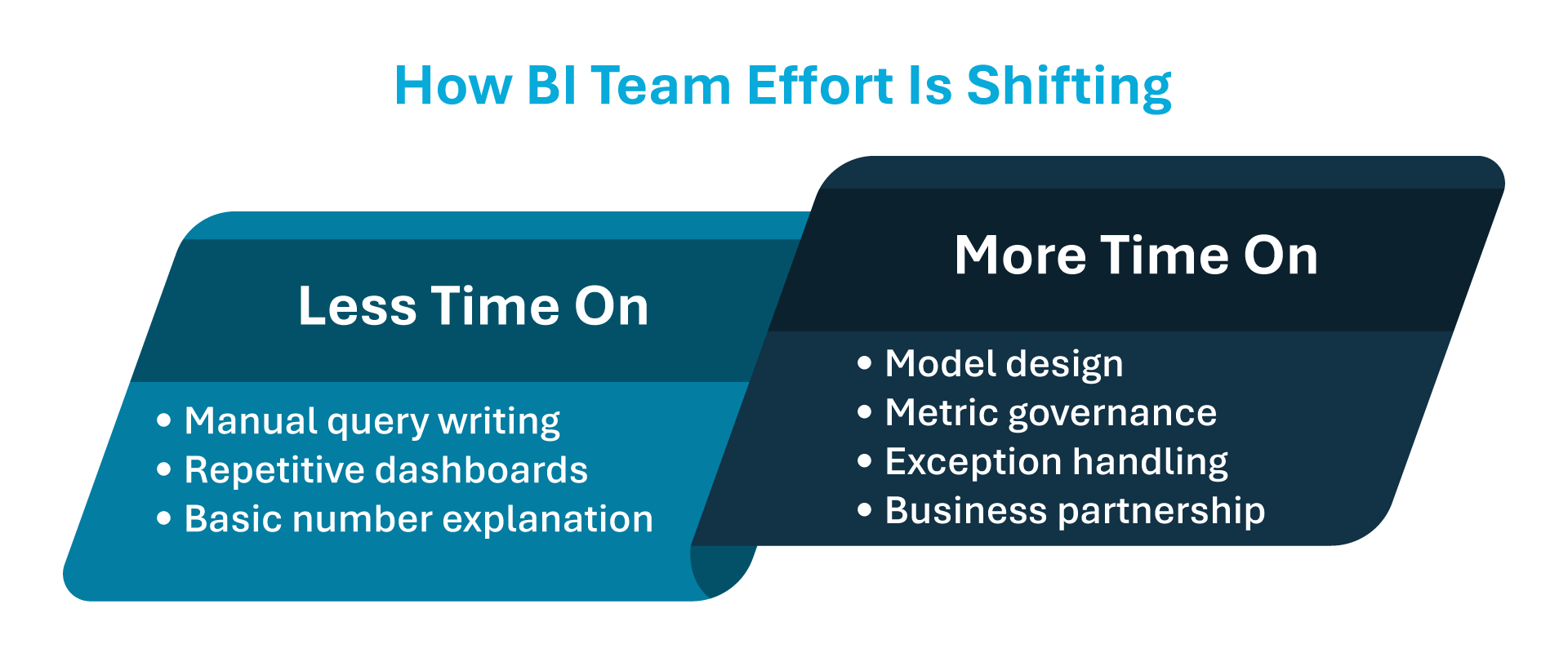
Less time spent on
- Manual query writing and syntax translation
- Repetitive report and dashboard building
- Basic explanation of what the numbers show
These tasks were necessary, but they were low leverage.
More time spent on
- Model design that reflects real business logic
- Metric governance to keep definitions aligned as teams grow
- Exception handling when data or behavior breaks expectations
- Partnering with the business to shape better questions
The skill shift
From operating tools -> To applying analytical judgment
This shift raises the bar. BI work becomes more strategic, more visible, and more directly tied to decision quality.
What This Means for Enterprise Analytics Leaders
AI changes how analytics work gets done, which means leaders must rethink how BI teams are measured and supported.
Measuring BI on output volume no longer makes sense. Counting dashboards, reports, or queries completed misses where value is actually created. What matters now is decision enablement, trust in the numbers, and responsiveness to changing business questions.
Leaders should be asking a different set of questions.
Where does friction still slow teams down today?
Which parts of the workflow should AI handle automatically?
And which parts must remain governed, reviewed, and owned by BI teams?
The answers to these questions shape operating models, not just tool choices.
AI is an amplifier. Teams with clarity around roles, standards, and accountability will move faster. Teams without them will feel more friction.
Conclusion: AI Makes BI Work More Human, Not Less
AI in modern BI powerhouses like SplashBI removes unnecessary friction, so teams can focus on what actually matters.
Mechanical tasks shrink. Judgment expands. BI fundamentals like data models, metric definitions, governance, and trust remain non-negotiable. Enterprises that succeed are not choosing AI instead of BI. They are combining the two intentionally, using AI to reduce handoffs without lowering standards.
The future of BI is better analytics work. Faster questions. Clearer answers. Stronger judgment where it counts.
Why Teams Are Pairing AI With SplashBI Analytics
Teams using SplashBI are seeing this shift in practice. With SplashAI and Analytics Co-Pilot, BI teams spend less time translating questions and more time shaping insight. Business users move faster without breaking governance. Standards stay intact while workflows become more human.
Talk to an Expert