People Analytics Is Expanding but Expectations Are Splitting
People Analytics Is Growing, But Not Evenly
People analytics has moved firmly into the enterprise spotlight. What was once treated as an HR reporting function is now a strategic priority, discussed in boardrooms alongside finance, operations, and growth. Research from Everest Group reinforces this shift, with analytics consistently ranking among the top enterprise investment areas.
But beneath this momentum sits a quieter, more uncomfortable reality.
Enterprises are no longer aligned on what success in people analytics actually looks like. Some organizations are pushing for predictive, AI-driven insight that connects workforce data directly to business outcomes. Others are still wrestling with basic reporting, fragmented data, and manual aggregation across systems.
It is the same market, often the same job titles, but fundamentally different expectations.
This divergence is shaping how people analytics platforms are evaluated, funded, and adopted. And it explains why results vary so widely across enterprises.
This blog is based on the Everest Group thought paper People Analytics in the Age of AI.
Download the thought paper to explore deeper benchmarks, maturity models, and evaluation frameworks.
The Illusion of a Single People Analytics Market
People analytics is often talked about as a single, steadily maturing category. The market narrative suggests universal progress. More dashboards. More data. More intelligence.
The reality is far more fragmented.
Enterprises are operating at very different levels of maturity. Some are still focused on descriptive and diagnostic analytics, using people data to understand what happened and why. Others are moving toward predictive and prescriptive use cases, modeling attrition risk, workforce demand, and future skills. A smaller but growing group is pushing further, treating people analytics as cross-domain, AI-enabled enterprise intelligence that connects workforce signals with financial and operational outcomes.
Lumping these organizations into one market creates confusion. Vendors end up talking past buyers, pitching advanced capabilities to teams still solving foundational problems. Buyers, in turn, benchmark themselves against peers who are operating at an entirely different level.
The gap is not ambition. Most organizations want better insight. The gap is readiness.
Group One: Enterprises Still Trying to Operationalize the Basics
A significant portion of enterprises are still focused on first-order people analytics problems. Their challenge is not insight. It is execution.
What this looks like in practice
- Fragmented HR systems that do not speak to each other
- Manual reporting stitched together in spreadsheets
- Limited integration with finance, sales, or operational data
Challenges observed in the Everest Group research
- Difficulty aggregating data across HR, finance, and operations
- No reliable single source of truth for workforce metrics
Why progress stalls
- Analytics remains confined to HR teams
- Heavy dependence on analysts and IT for even routine questions
The result is familiar. Dashboards exist, but decisions still rely on instinct and experience rather than evidence.
For these organizations, AI often feels premature. The bottleneck is not intelligence. It is infrastructure. Until data is integrated, governed, and trusted, advanced analytics and AI will struggle to deliver meaningful value.
Group Two: Enterprises Pushing Toward AI-Driven Intelligence
More mature enterprises are no longer satisfied with dashboards and historical reports. They expect intelligence that helps them act.
What these organizations expect
- Predictive insights that anticipate attrition, skills gaps, and workforce risk
- Explainable AI that shows how conclusions are reached
- Conversational access to data through natural language, not dashboards alone
Everest Group highlights a clear shift here. People analytics is moving from systems of record to systems of execution, where insights are delivered in the flow of work and tied directly to decisions.
Who is driving this demand
- Executives seeking workforce signals aligned to business outcomes
- Business leaders who need timely, actionable insight
- People managers who want answers without waiting on analysts
What success looks like
- Insights delivered in context, not buried in reports
- Actions triggered based on risk and opportunity, not after-the-fact analysis
These organizations evaluate people analytics as enterprise intelligence, not HR tooling.
What’s Actually Driving the Split
The widening gap in people analytics expectations is not philosophical. It is structural. Enterprises are responding to the same trends, but from very different starting points.
Three forces, highlighted in the Everest Group research, are driving this split.
AI readiness: Organizations without governed, reliable data struggle to apply AI in any meaningful way. When data quality, definitions, and access are inconsistent, AI amplifies confusion instead of insight. For these teams, AI feels promising in theory but disappointing in practice.
Data aggregation maturity: HR data alone is no longer enough. The real value of people analytics emerges when workforce data is linked with finance, sales, and operational metrics. Enterprises that have not solved aggregation across systems remain stuck in siloed reporting, while others move toward cross-domain intelligence.
The context gap: Metrics without business context rarely influence decisions. When workforce data is disconnected from outcomes like productivity, cost, or growth, insights fail to travel beyond HR.
The insight is clear. The split reflects how enterprises think about analytics itself. Some still see it as reporting. Others treat it as decision infrastructure.
Why People Analytics Is Being Re-Evaluated as Enterprise Intelligence
People analytics is no longer judged on HR outcomes alone. As Everest Group points out, its value is increasingly tied to cross-domain intelligence, not isolated workforce metrics.
Workforce data is now being evaluated alongside core business signals. Productivity. Revenue. Cost. Risk. Leaders want to understand not just what is happening in the workforce, but how those patterns influence business performance. That shift is changing how people analytics platforms are assessed.
The evaluation criteria are expanding. Can insights scale beyond HR teams and influence business leaders? Can non-technical users ask questions and act on answers without waiting for analysts or custom reports?
Conversational interfaces play a critical role here. By allowing users to interact with data through natural language, they democratize access to insight and reduce dependence on specialized analytics teams. Decisions move closer to the moment they matter.
The broader insight is clear. People analytics platforms are evolving into enterprise intelligence layers, connecting workforce insight to organizational outcomes rather than operating as standalone HR tools.
What This Means for HR and Business Leaders
As people analytics expectations diverge, leaders face a practical decision point. Before investing further, expectations must align with maturity.Questions leaders should be asking
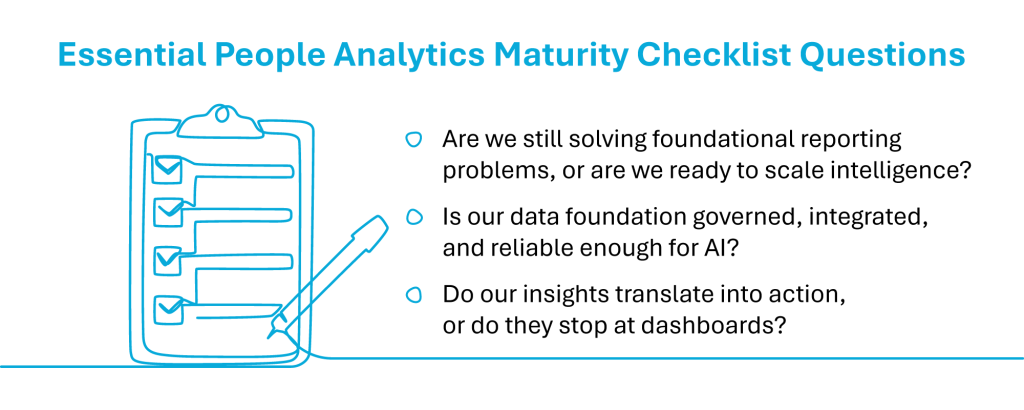
Skipping maturity stages creates disappointment. Organizations that jump to AI without fixing aggregation, definitions, and context often see stalled adoption and eroding trust.
The insight is straightforward. Success is not about adopting AI because the market demands it. It is about aligning analytics strategy with organizational readiness. When foundations and expectations match, people analytics can finally deliver on its promise.
Conclusion: Growth Is Guaranteed. Outcomes Are Not.
People analytics is not moving backward. It is splitting forward.
Demand will continue to rise, but outcomes will diverge sharply. Enterprises that invest in strong data aggregation, business context, and scalable intelligence will pull ahead. Those that treat people analytics as isolated reporting will struggle to convert insight into action.
This divide has nothing to do with intent. It is driven by foundations.