Most organizations already have dashboards. That is no longer the problem.
The real problem is this: people still leave the application they are working in just to find answers they need to make a decision.
- A finance user jumps from Oracle Fusion into a BI portal to validate budget variance.
- A sales manager leaves the CRM to check pipeline trends.
- An HR leader exports reports into spreadsheets because the analytics tool is disconnected from the workflow.
That friction matters more than most companies realize.
It slows decisions. It reduces adoption. And it creates a dangerous gap between insight and action.
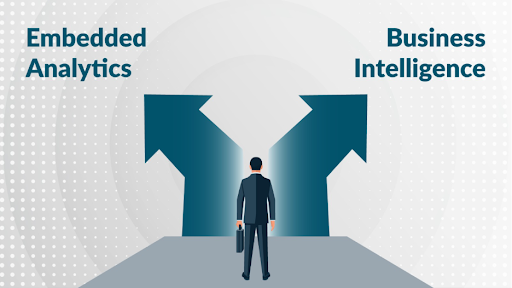
Which is exactly why the debate around embedded analytics vs business intelligence has become so important.
Organizations are realizing that standalone BI tools are great for analysis, but not always great for operational decision-making. Meanwhile, embedded analytics is reshaping how people consume data directly inside ERP systems, CRMs, portals, and enterprise applications.
But these are not competing categories in the way people often assume.
In many enterprises, embedded analytics and business intelligence work together. The challenge is understanding where each fits, what each does well, and where traditional BI starts to break down.
In this embedded analytics vs business intelligence guide, we’ll break down:
- Embedded analytics vs business intelligence explained simply
- Key differences between embedded analytics and BI
- Use cases across ERP, CRM, HR, and customer portals
- When embedded analytics makes more sense
- Where traditional business intelligence still wins
- How modern platforms like SplashBI combine both approaches
Also read: Augmented analytics examples
What Is Business Intelligence?
Business intelligence, or BI, refers to platforms and tools that help organizations collect, analyze, visualize, and report on data.
Traditional business intelligence systems are usually centralized analytics environments where users:
- Build dashboards
- Run reports
- Analyze trends
- Explore KPIs
- Create executive scorecards
- Perform ad hoc analysis
Think of platforms like Tableau, Power BI, or standalone enterprise reporting environments.
The workflow typically looks like this:
Business application → data warehouse → BI platform → dashboard/report → user action
This model transformed enterprise analytics for years because it created visibility across the organization.
But it also introduced a major operational issue.
Users often had to leave their day-to-day systems to access insights.
That sounds minor until you realize how work actually happens inside enterprises.
- Finance teams live inside ERP systems.
- Sales teams live inside CRMs.
- HR teams live inside HCM platforms.
- Operations teams live inside supply chain systems.
The more disconnected analytics becomes from those workflows, the less likely users are to consistently engage with it.
That is where embedded analytics enters the picture.
What Is Embedded Analytics?
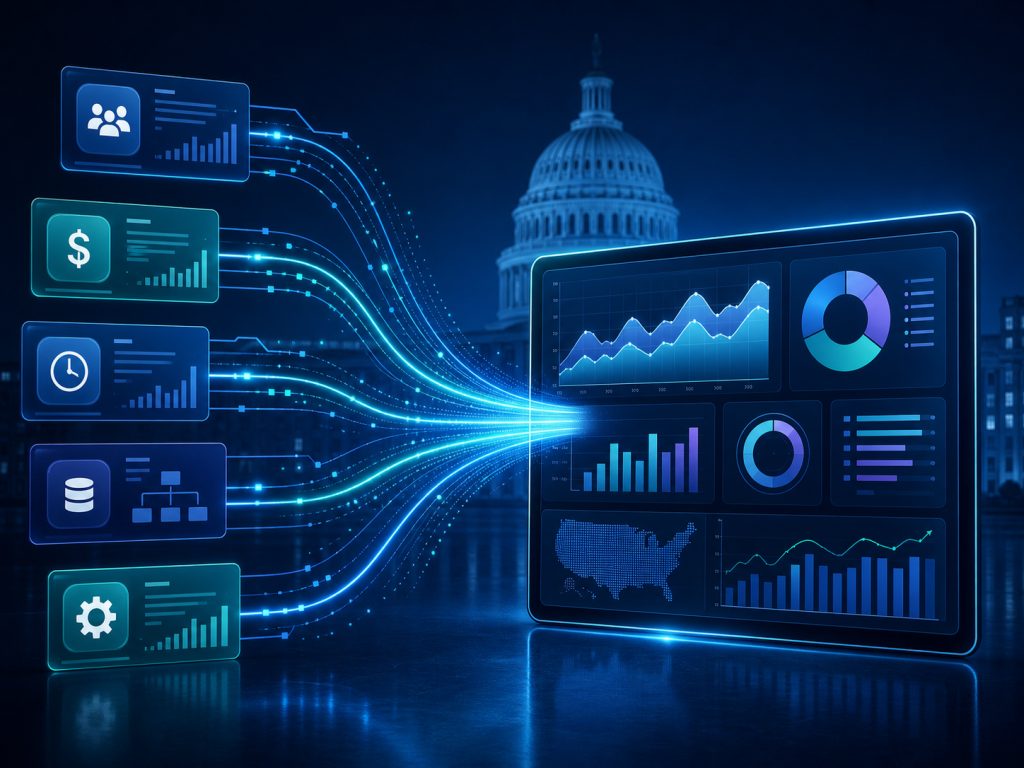
Embedded analytics integrates dashboards, reporting, KPIs, AI-driven insights, and data exploration directly into the application people already use.
Instead of switching to a separate BI portal, users consume analytics inside:
- ERP applications
- CRM platforms
- HR systems
- Supplier portals
- Customer portals
- Procurement systems
- Internal enterprise apps
The key difference is contextual delivery.
Analytics appears exactly where decisions happen.
For example:
- A procurement manager sees supplier spend trends directly inside Oracle Procurement
- A sales rep views opportunity risk insights within Salesforce
- An HR leader analyzes attrition trends inside a workforce planning dashboard
- A customer using a portal sees account usage analytics without opening another tool
This reduces friction dramatically.
Instead of asking users to “go analyze data,” embedded analytics brings insights into the operational workflow itself.
And increasingly, this is where enterprise analytics is heading.
How Is Embedded Analytics Different From Business Intelligence?
This is the core question organizations are asking today.
At a high level:
- Business intelligence centralizes analytics
- Embedded analytics operationalizes analytics
But the deeper differences go beyond that.
Embedded Analytics vs Business Intelligence Comparison Table
| Feature | Embedded Analytics | Business Intelligence |
|---|---|---|
| Primary purpose | Deliver insights within workflows | Centralized analysis and reporting |
| User experience | Inside applications | Separate BI environment |
| Typical users | Operational users | Analysts, managers, executives |
| Context awareness | High | Moderate |
| Speed to action | Faster | Slower |
| Adoption rates | Typically higher | Depends on BI maturity |
| Best for | Real-time operational decisions | Strategic and historical analysis |
| Data exploration depth | Moderate to advanced | Advanced |
| Workflow integration | Native | Usually external |
| Examples | ERP dashboards, CRM insights, customer portals | Enterprise BI platforms |
The biggest difference is behavioral. Traditional BI assumes users will proactively seek out insights. Embedded analytics assumes users are busy and brings insights to them instead.
That sounds subtle. It is not. It changes adoption, engagement, and decision velocity across the organization.
Why Embedded Analytics Is Growing Faster Than Traditional BI
Traditional business intelligence is not disappearing.
But embedded analytics is growing rapidly because enterprise software behavior has changed.
Users now expect analytics to work the same way consumer technology works:
- Contextual
- Instant
- Personalized
- Embedded into workflows
- Actionable in real time
Nobody wants another tab. Nobody wants another login. Nobody wants to leave the workflow just to validate a number.
This is especially true in ERP and enterprise operations environments where users already navigate complex systems daily.
The more steps required to access insight, the lower the adoption.
That is one reason many organizations spend millions on BI platforms only to discover that most employees barely use them.
The issue is not always dashboard quality.
It is workflow distance.
Embedded Analytics vs Business Intelligence in ERP Systems
ERP systems are one of the clearest examples of where embedded analytics creates value.
Traditional ERP reporting often struggles with:
- Slow report generation
- IT dependency
- Limited self-service
- Static dashboards
- Delayed insights
- Spreadsheet exports
In many organizations, finance teams leave the ERP entirely to analyze data elsewhere.
That creates multiple problems:
- Version inconsistencies
- Governance gaps
- Manual reconciliation
- Delayed close cycles
- Reduced trust in numbers
Embedded analytics changes that dynamic.
Instead of exporting data into separate tools, users can:
- Drill into transactions directly
- Analyze budget variances in context
- Explore operational KPIs in real time
- Ask conversational AI questions inside dashboards
- Navigate from summary metrics to transaction-level detail
This is where modern enterprise analytics platforms like SplashBI are reshaping the experience.
Rather than forcing users into separate BI portals, platforms increasingly embed analytics directly into ERP workflows while still preserving enterprise governance.
For Oracle environments especially, this matters because finance users need both:
- Operational context
- Governed reporting
Not one or the other.
Embedded Analytics vs Business Intelligence in CRM Platforms
CRM systems are another major battleground in the embedded analytics vs business intelligence discussion.
Traditional BI gives leadership visibility into:
- Pipeline trends
- Revenue forecasting
- Territory performance
- Win rates
- Sales productivity
But operational sales teams often need something different.
They need insights while managing deals.
Examples include:
- Opportunity risk indicators
- Pipeline health scores
- Activity trends
- Engagement metrics
- AI-generated recommendations
- Forecast changes
If those insights exist only inside a BI dashboard nobody checks regularly, the value drops significantly.
Embedded analytics solves this by integrating intelligence directly into the CRM experience.
The result is faster decision-making and higher user engagement.
This is one reason modern sales platforms increasingly prioritize embedded intelligence over standalone reporting alone.
Embedded Analytics vs Business Intelligence for Customer Portals
Customer portals may be the strongest use case for embedded analytics.
Why?
Because customers should never need a separate BI tool just to understand their own data.
Embedded analytics allows organizations to surface:
- Usage trends
- Billing metrics
- Support performance
- Financial summaries
- Operational KPIs
- Benchmarking insights
directly inside customer-facing applications.
This creates a dramatically better user experience.
It also turns analytics into a product differentiator.
Many SaaS companies now compete partly on how well they deliver customer-facing analytics experiences.
Traditional BI platforms were never designed primarily for this.
Embedded analytics platforms were.
When Business Intelligence Still Makes More Sense
Despite the momentum around embedded analytics, traditional business intelligence still matters enormously.
In fact, organizations often fail when they assume embedded analytics should replace BI entirely.
That is rarely the right strategy.
Business intelligence remains critical for:
- Enterprise-wide reporting
- Cross-functional analysis
- Historical trend exploration
- Executive dashboards
- Deep ad hoc analytics
- Complex data modeling
- Governance-heavy reporting
- Centralized KPI management
Embedded analytics excels at operational decision support.
Business intelligence excels at broad organizational analysis.
The smartest organizations combine both.
Embedded Analytics vs BI Decision Framework
| If your priority is… | Best approach |
|---|---|
| Operational decision-making | Embedded analytics |
| Executive reporting | Business intelligence |
| Customer-facing insights | Embedded analytics |
| Cross-functional analytics | Business intelligence |
| Workflow productivity | Embedded analytics |
| Advanced data exploration | Business intelligence |
| Real-time contextual insights | Embedded analytics |
| Enterprise governance | Both together |
The Future Is Not BI vs Embedded Analytics. It’s Both.
This is where many conversations around embedded analytics vs business intelligence become misleading.
The future is not about choosing one and abandoning the other.
The future is about convergence.
Modern analytics platforms increasingly combine:
- Embedded dashboards
- Self-service reporting
- AI-driven explanations
- Conversational analytics
- Context-aware drilldowns
- Governed enterprise reporting
- Cross-functional visibility
inside a single governed ecosystem.
That shift matters because organizations are realizing something important:
Users do not care about analytics architecture.
They care about getting answers quickly.
The analytics market is moving away from “dashboard destinations” and toward “decision intelligence embedded everywhere.”
Which is also why AI is accelerating this trend.
As conversational analytics grows, users increasingly expect to:
- Ask questions directly inside applications
- Receive contextual explanations
- Explore insights without technical skills
- Move from insight to action instantly
That future aligns much more naturally with embedded analytics than standalone BI environments alone.
How SplashBI Bridges Embedded Analytics and Business Intelligence
One reason organizations struggle with analytics modernization is because many platforms force an either-or choice.
Either:
- Deep enterprise BI
- Lightweight embedded dashboards
But enterprise users increasingly need both.
SplashBI approaches this differently.
The platform combines governed business intelligence capabilities with embedded analytics experiences across ERP, HCM, finance, operations, and enterprise workflows.
That means organizations can:
- Embed dashboards directly into operational workflows
- Enable self-service reporting
- Drill into transaction-level detail
- Use conversational analytics within dashboards
- Maintain enterprise governance and security
- Deliver contextual AI-powered insights
- Support both operational users and executive stakeholders
This becomes especially valuable in Oracle environments where organizations often struggle with fragmented reporting experiences across ERP, HCM, EPM, and operational systems.
Rather than forcing users into disconnected reporting silos, embedded analytics helps bring intelligence closer to the actual point of decision-making.
And increasingly, that is what modern enterprises expect from analytics platforms.
Conclusion
The debate around embedded analytics vs business intelligence is not really about which one is better.
It is about where analytics creates the most value.
Traditional business intelligence remains essential for enterprise-wide visibility, governance, and deep analysis.
But embedded analytics solves a different problem entirely.
It reduces the distance between insight and action.
And in modern enterprises, that distance matters more than ever.
Because the organizations moving fastest today are not necessarily the ones with the most dashboards.
They are the ones delivering insights directly where work happens.
That is the real shift behind embedded analytics.
And it is why modern analytics strategies increasingly combine embedded intelligence with enterprise BI instead of treating them as competing approaches.
If your organization is trying to modernize analytics across ERP, HCM, finance, operations, or customer workflows, SplashBI helps bridge that gap with embedded, AI-powered, governed analytics experiences built for enterprise scale.
Ready to see how SplashBI combines embedded analytics and business intelligence in one unified platform?
FAQs
What is the difference between embedded analytics and business intelligence?
The main difference between embedded analytics and business intelligence is where users consume insights. Embedded analytics delivers dashboards and insights directly inside applications like ERP or CRM systems, while business intelligence platforms typically exist as separate analytics environments used for broader reporting and analysis.
Is embedded analytics replacing business intelligence?
No. Embedded analytics is not replacing business intelligence. Most organizations need both. Embedded analytics supports operational workflows and real-time decision-making, while business intelligence supports enterprise reporting, governance, and strategic analysis.
What are examples of embedded analytics?
Examples of embedded analytics include:
- Sales insights inside a CRM
- Financial dashboards inside an ERP
- HR analytics inside an HCM platform
- Customer usage dashboards inside a SaaS portal
- AI-powered recommendations within enterprise applications
Why is embedded analytics important?
Embedded analytics is important because it improves analytics adoption, reduces workflow friction, and helps users make decisions faster. Instead of switching between applications and dashboards, users receive contextual insights directly where they work.
What industries use embedded analytics the most?
Industries heavily using embedded analytics include:
- Finance
- Healthcare
- SaaS
- Retail
- Manufacturing
- HR technology
- Supply chain and logistics
These industries rely on operational decision-making where contextual, real-time insights are critical.