

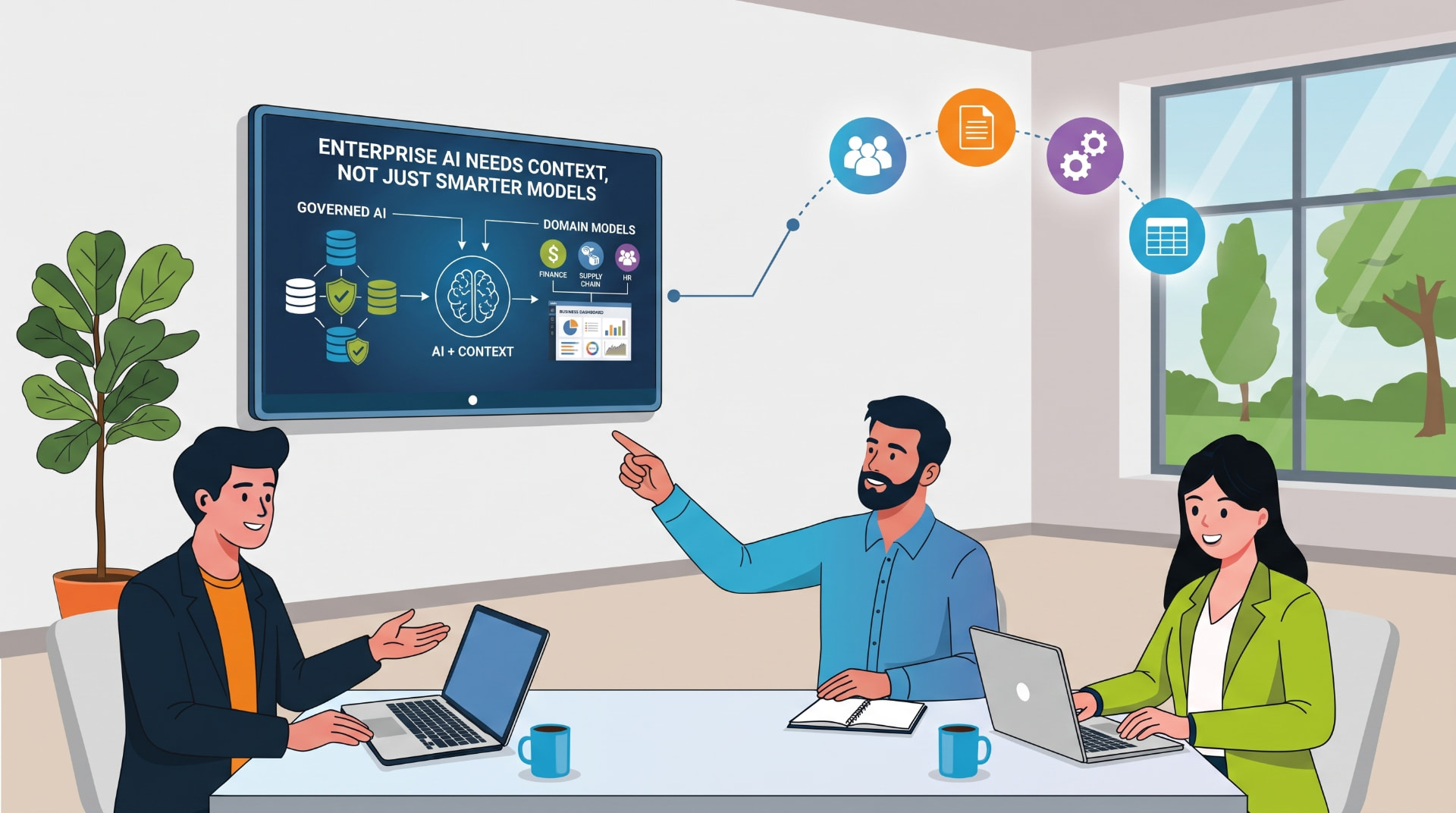
The next enterprise AI advantage is already hiding in the business
We have spent the last several years making AI models smarter. They reason better, understand more language, and generate increasingly sophisticated queries. Yet a deceptively simple problem persists: an AI system can understand a business question perfectly and still return the wrong business answer.
Ask for headcount at the end of last quarter. An LLM can generate valid SQL in seconds. But should the answer include contractors? Employees on leave? Multiple assignments? Which historical organizational hierarchy applies? The database may return a precise number while the business answer remains wrong.
My conviction is that the next competitive advantage in enterprise AI will come less from the model itself and more from the business context that surrounds it. This is the foundation of our strategy at SplashBI.
The challenge is not simply teaching AI what a metric means. It is teaching AI how the business produced that metric.
SplashBI starts where business meaning starts: at the source
Enterprise applications encode years of operational decisions. In Oracle EBS and Fusion, accounting periods, ledgers, subledgers, charts of accounts and flexfields influence the meaning of financial data. In HCM, effective-dated assignments, employment relationships and organization structures determine the meaning of workforce measures. Similar complexity exists across procurement, supply chain and operations.
Much of this knowledge disappears when teams treat enterprise data as just rows and columns. A warehouse can organize data and a semantic model can define a metric, but neither automatically recovers the rules and relationships embedded in its original application.
SplashBI combines enterprise data acquisition and prebuilt domain models with governed analytics. Our differentiation begins with understanding the transactional systems that created the data, preserving the relevant relationships and making that intelligence reusable. The ambition is not to ask an LLM to rediscover a general ledger every time a CFO asks a question.
Figure 1. SplashBI enterprise intelligence foundation
Oracle EBS / Fusion Finance · HCM · SCM | Workday / UKG Workforce and HR | Other enterprise systems ERP · CRM · Operations |
|---|
Enterprise data acquisition Connectors · Pipelines · Source-system understanding |
|---|
Governed business context Prebuilt domain models · Semantics · Hierarchies · Time · Security · Lineage |
|---|
BI Reports and dashboards | SplashAI Conversational analysis | Agent-ready direction Governed AI consumption |
|---|
Conceptual SplashBI architecture. Agent consumption indicates an architectural direction, not a claim that every capability is commercially available.
Cross-domain intelligence changes the value equation
The questions that matter most to executives rarely fit inside one software application. A CFO may want to know how attrition and overtime affected operating margin. A CHRO may want to connect recruiting delays to productivity and cost. A supply chain leader may want to understand how procurement choices affect cash and service levels.
These questions require more than fetching numbers from different systems. Each domain has its own grain, time logic, definitions and permissions. The answer depends on understanding how the domains relate and which comparisons are valid.
SplashBI's prebuilt models across Finance, HCM, Supply Chain and Operations are designed to reduce the effort needed to create this shared understanding. That is where I see durable value: not in producing a single impressive AI answer, but in consistently connecting business outcomes across the enterprise.
The real value is not knowing individual metrics. It is understanding the relationships between them.
The AI × BI flywheel: trusted intelligence compounds
At SplashBI, we do not see AI replacing business intelligence. We see AI increasing the value of the governed intelligence enterprises have already built.
BI contributes validated metrics, models, security and established analytical processes. AI adds natural-language access, richer explanation and new ways to consume information. Evaluation and explicit feedback can help identify gaps and improve the governed foundation over time. Those improvements then benefit both the dashboards people use today and the intelligent experiences they adopt tomorrow.
Figure 2. The SplashBI AI × BI flywheel
Trusted enterprise data Source relationships · Security · Quality |
|---|
Business intelligence Validated metrics · Reports · Domain models |
|---|
AI intelligence Natural language · Insight · Explanation |
|---|
Controlled improvement Evaluation · Feedback · Model refinement |
|---|
↻ Validated improvements strengthen the governed foundation
The flywheel is an architectural principle. Changes to definitions and permissions remain subject to governance and validation.
Why a semantic layer is necessary, but not sufficient
A semantic layer establishes agreed definitions for metrics and dimensions. Semantic compilation can translate governed definitions into executable queries. Both matter, especially when dashboards, conversational interfaces and AI agents are expected to deliver consistent results.
But an enterprise also needs to know why a metric has its particular meaning in a given business context. Which source transaction created it? Which effective date matters? Which organizational hierarchy applied at that point in time? Which user is allowed to see it? How does the metric connect to outcomes in another domain?
I think of this as enterprise context: the transactional relationships, application rules, historical structures, entitlements and domain knowledge that connect business definitions to operational reality.
Figure 3. Three complementary capabilities
Semantic layer Defines business meaning: metrics · dimensions · definitions |
|---|
Semantic compiler Makes governed meaning executable: query logic · reuse |
|---|
Enterprise context Grounds meaning in reality: transactions · time · policies · cross-domain relationships |
|---|
These capabilities complement one another. The diagram describes their roles, not a mandatory implementation order.
From plausible SQL to trusted business answers
Natural-language-to-SQL has made analytics dramatically more accessible. But technical validity is only the starting point. A query can execute while joining the wrong records, selecting the wrong fiscal period, or bypassing an important business rule.
The architecture I believe will win separates user intent from business execution. Models can interpret the question. Governed semantics and source-aware context can resolve definitions and relationships. Query validation and authorization can constrain execution. Results can then be checked, explained and traced back to their source.
This is also how we should measure success. The benchmark is not just SQL syntax or query execution. It is the correct business answer, for the correct user, under the correct business rules, consistently and explainably.
Figure 4. Evolving the enterprise AI query path
Common Text2SQL pattern Question → LLM + schema → Generated SQL → Database | Governed intelligence pattern Question → Intent → Semantic + contextual resolution → Authorized execution |
|---|
Enterprise reality is heterogeneous
A global enterprise might use Oracle for Finance, Workday for HCM, Salesforce for CRM and Snowflake or Databricks for analytical workloads. Acquisitions, regional obligations and existing investments make this complexity durable.
A trusted intelligence foundation should work across this environment, not require the enterprise to standardize on a single application, warehouse or AI model. That is why we have emphasized interoperability, domain knowledge and deployment flexibility in SplashBI's architecture. The business context should remain useful as models, interfaces and data platforms evolve.
What Workday and Honeydew tell us about the market
Workday's November 18 announcement of its intent to acquire Honeydew is another indication that the industry recognizes the importance of governed business semantics. Honeydew's semantic compiler focuses on translating shared definitions into consistent, executable queries for AI and BI. That is a meaningful advance.
For me, the larger signal is that enterprises need reusable business meaning outside any individual model or user interface. SplashBI's opportunity is to connect that meaning to source-specific transactional knowledge, cross-domain models and governed analytics across heterogeneous systems. Semantic compilation can strengthen this vision, but enterprise context is the broader challenge.
My prediction: enterprise context becomes the moat
Models will improve. Inference costs will fall. Natural-language interfaces will become increasingly common. What will remain difficult to replicate is the accumulated knowledge of how a specific enterprise actually operates: its ledgers, assignments, hierarchies, business exceptions, security policies and relationships between domains.
At SplashBI, we are building toward an intelligence foundation that makes this knowledge more accessible and reusable across BI and AI. Our advantage is the combination of source-system expertise, prebuilt enterprise models, governed access and a platform approach that works with the systems customers already use.
Semantic layers define meaning. Semantic compilers make meaning executable. Enterprise context connects meaning to how the business actually operates.
The next generation of enterprise AI will be judged not by how fluently it answers a question, but by how reliably it understands the business behind the answer.
References
Constellation Research, “Workday acquires Honeydew for its AI and BI semantic compiler,” November 2026. https://www.constellationr.com/insights/news/workday-acquires-honeydew-its-ai-and-bi-semantic-compiler
SplashBI, Enterprise Intelligence Platform. https://splashbi.com/enterprise-intelligence-platform
SplashBI, corporate website. https://splashbi.com/

Venkat Ramamurthy is Chief AI Officer at SplashBI, where he leads AI strategy and innovation across enterprise business intelligence and AI-powered analytics. His experience includes enterprise AI and software leadership roles at Amazon, Phenom and UKG.