

A business can meet its headcount target and still miss its operating plan.
In a recent working session, an HRBP told us her leaders had been asked to cut workforce costs by 5% while expanding implementation capacity. “I can show them where costs are rising and who’s leaving,” she said. “What I can’t show them is which changes will free up capacity and which ones will break delivery.”
They could consolidate overlapping activities, redeploy people, change management responsibilities, or revise hiring plans. Each option creates a different organization, even when the financial target is the same.
Strategic workforce intelligence connects those choices to evidence. It brings People Analytics, organizational design, and business priorities into a shared decision process, helping leaders evaluate changes before committing to them and assess the results afterward.
People Analytics provides the foundation
People Analytics already serves a strategic purpose. The CIPD describes its role in solving business problems, including predicting workforce needs and evaluating interventions.
SplashBI customers have used People Analytics for years to do exactly this.
Organizational design adds a complementary perspective: how roles, responsibilities, processes, and structures should support the business strategy.
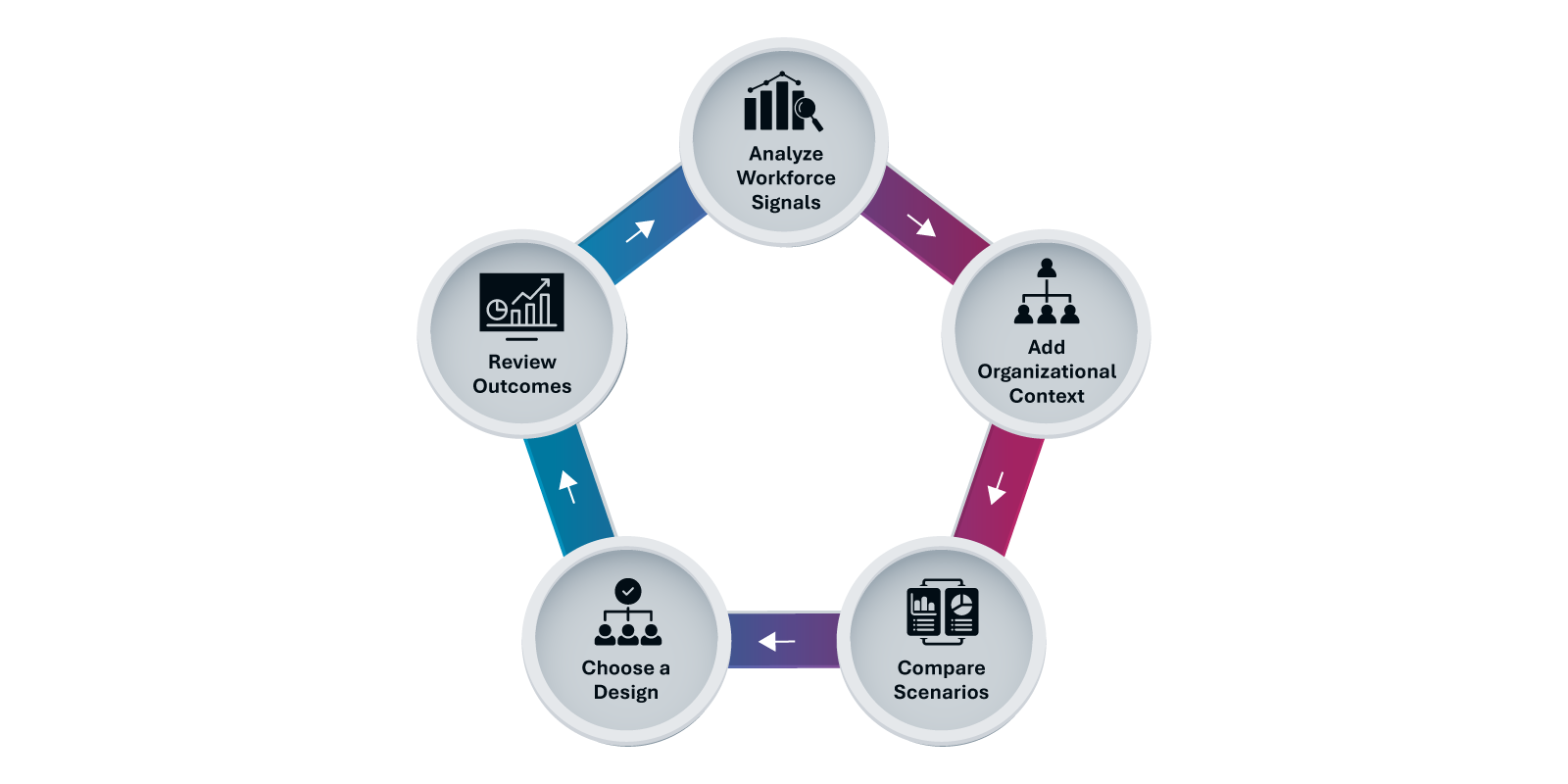
Together, these capabilities help leaders investigate what a workforce signal means for the organization.
Rising attrition among experienced specialists, for example, could prompt a compensation review. Examining responsibilities and reporting relationships might also reveal that these employees support several teams without the authority or resources to resolve recurring problems. The decision then expands to include workload, management support, and role design.
Strategic workforce intelligence connects what leaders know about their people with the choices they make about how work gets done.
Evaluate capacity in the context of the work
Two teams with identical headcounts can have very different delivery capacity. One may have experienced employees and clear ownership. Another may depend on a single specialist, carrying critical vacancies, or spending hours navigating approvals.
Changing skill requirements make this distinction more pressing. The World Economic Forum’s Future of Jobs Report 2025 estimates that 39% of workers’ existing skills will change or become outdated between 2025 and 2030, based on employers’ expectations. Maintaining headcount therefore offers limited reassurance if the business needs different capabilities.
Management structure deserves the same scrutiny. Gallup’s January 2026 analysis highlights how appropriate team size depends on managers’ own delivery responsibilities, their ability to lead, and the support employees receive. A wider management span can have very different consequences for an established operations team and a team developing a new service.
Data can make two teams look interchangeable when they are not, and we see this often. One customer’s data flagged two teams that looked duplicated. When the HRBP walked through it with the managers, it turned out the teams covered different shifts, and cutting one would have left nights uncovered. A small team can hold specialist coverage the same way.
Use workforce data to identify where to investigate. Then test the interpretation with the people doing the work.
Compare alternatives against the same business objective
A useful scenario starts with a defined outcome, such as expanding implementation capacity within the current cost base. HR, Finance, and business leaders should agree on the baseline, the timing, and the capabilities or service levels each option must protect.
Compare each credible alternative with the current arrangement, identifying what work stops, what moves, and who takes over what moves. Removing a management layer, for instance, requires naming who will absorb its coaching, escalation, and coordination duties.
Treat the economics with the same rigor: canceling a vacant role cuts planned spending and redeploying staff may avoid a future hire, but neither reduces current payroll on its own.
Consider an illustrative redesign that removes $1.4 million in annual payroll costs but adds $400,000 in recurring coverage and technology expenses. Net recurring savings are $1 million. Another $300,000 in transition costs reduces first-year savings to $700,000, assuming a full year of recurring benefits and costs.
Making assumptions visible helps leaders distinguish an attractive headline from a financially workable plan. It also shows when a decision depends on uncertain productivity gains, rapid reskilling, or implementation happening on schedule.
Test whether the change delivered its purpose
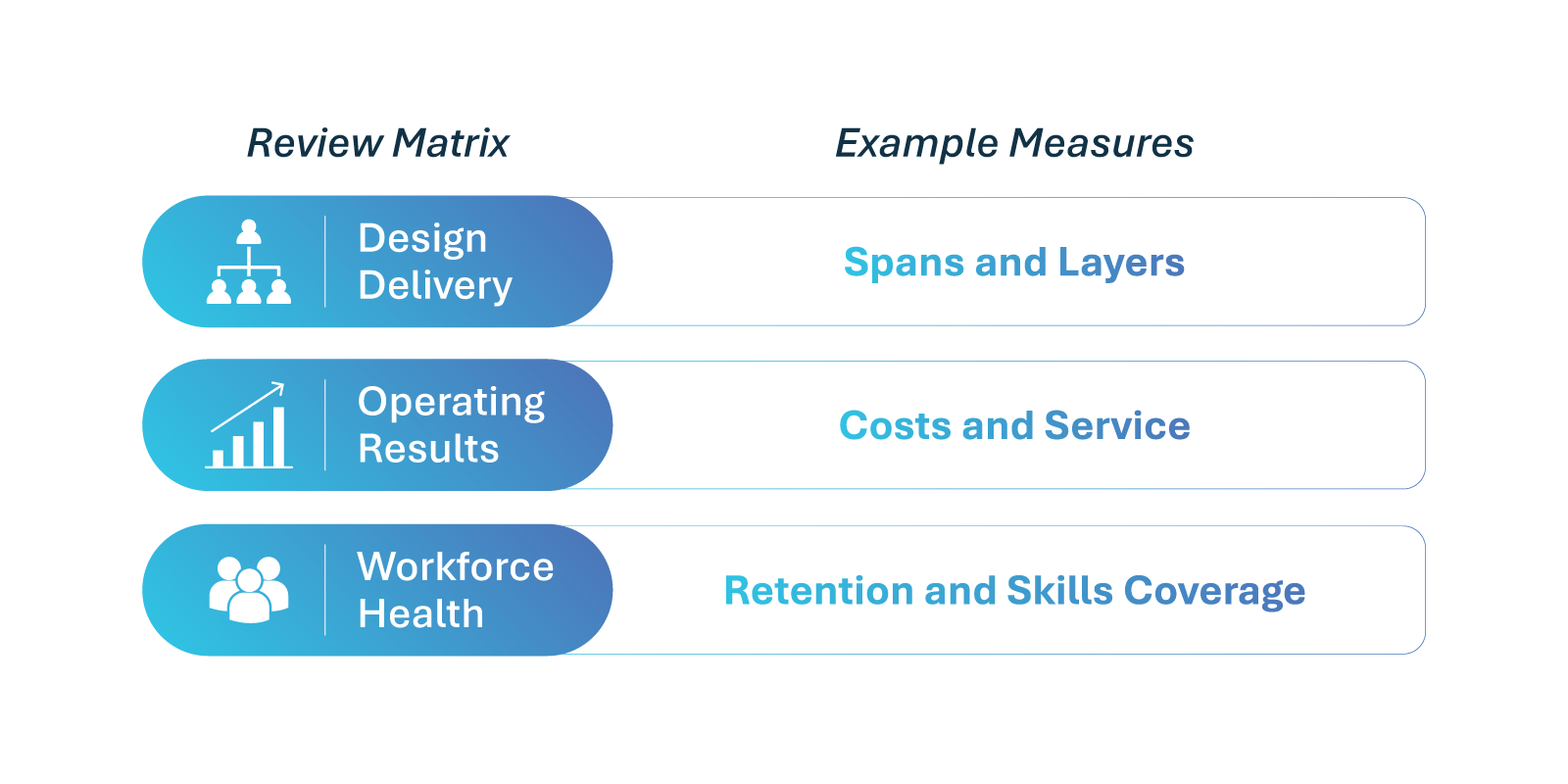
An approved structure creates a testable expectation. Leaders need to check both whether the design was implemented and whether it produced the intended result.
Structural measures include team sizes, reporting relationships, spans, and layers. Outcome measures should reflect the original business objective: actual costs, service performance, critical-role retention, or skills coverage.
Set the review cadence before implementation and retain the original baseline. Monthly structural checks can reveal deviations from the design, while operational measures may need more frequent attention. Consider changes in demand or other initiatives before attributing an improvement entirely to the redesign.
How SplashBI bridges the People Analytics and workforce intelligence gap
SplashBI People Analytics connects data across HCM, recruiting, payroll, and finance, so leaders can see workforce trends and risks in one place. SplashAI lets them ask questions in plain language, within governed permissions.
When we walk customers through their People Analytics, the follow-up question is almost always the same: “Okay, so what should we change?” One HR leader put it simply: her CFO doesn’t want another dashboard; he wants options with a price tag. That’s why we built OrgLenz. Where People Analytics is analytical, OrgLenz is strategic. It lets leaders examine their organizational structure, compare costed alternatives side by side, and check teams each month against the approved design on size, spans, and layers. Those checks sit alongside People Analytics and operational measures, so leaders can see whether a change actually delivered what it promised.
OrgLenz’s calculation engine produces the numbers. AI agents help propose research options. The product is read-only, and leaders retain responsibility for workforce decisions and their implementation.
For HR and business leaders, the practical starting point is one consequential workforce decision. Agree on the evidence, compare viable options, and define how success will be assessed. The result is a recommendation that leaders can explain, challenge, and improve as conditions change.

Ragu brings deep expertise in people analytics and workforce strategy. At SplashBI, he leads analytics innovation and customer advisory, shaping product roadmaps and cloud data architecture to help organizations gain maximum value from prebuilt KPIs, predictive models, and real-time insights. With deep expertise in the Oracle ecosystem and strategic vision in business intelligence solutions, he strengthens the platform’s ability to deliver scalable, high-impact analytics. Ragu engages closely with HR and business leaders across industries – his perspective bridges product capabilities with the pressing needs of HR leaders navigating today’s fast-changing talent landscape.