Analytics and Machine learning have established their profitability in every industry. As the complexity of Machine learning techniques grows, it is imperative to find efficient ways to successfully put together the data to train these powerful ML models. Data, which is considered the ‘fuel of machine learning, is in the raw form and needs to be processed/refined into features to train a model. The effort put in data extraction, cleansing, and transformation loses its impact if the most significant features are not identified to drive the model. This highlights the importance & advantages of Feature engineering.
What is Feature Engineering and its main goals?
What is Feature Engineering?
Features are the fundamental elements of a data set. In simpler terms, ‘Gender’ is a feature in the data set and can have specific male/female values.
The process of identifying & extracting relevant features from raw data for a machine learning algorithm is called feature engineering. It starts from selecting the most important characteristics (features), their transformation using mathematical operations, construction of new variables as per the requirement, and feature extraction.
For example, ‘Salary’ is an existing feature. At the same time, ‘Compa-ratio’ is a newly created feature to compare an employee’s salary with the median salary of the role. Coming up with features is difficult & time-consuming and requires expert knowledge. In short, it is the process of applying domain knowledge to identify existing /create new features from the data set.
Usually, the HR data is ill-managed and is in its crudest form. It requires domain expertise to develop an accurate, easy to train/retrain & computationally inexpensive data analytical model by identifying the aptest features. Before the data scientist can zero in on the best-suited algorithm that can be used for modeling, a domain expert should identify which features will significantly contribute to the model. Simply including a high number of features does not translate to a better model. On the other hand, using too few features affects the accuracy of the results. A domain expert with a knowledge of data science can balance performance & accuracy by selecting the optimum attributes that can affect the output of the process.
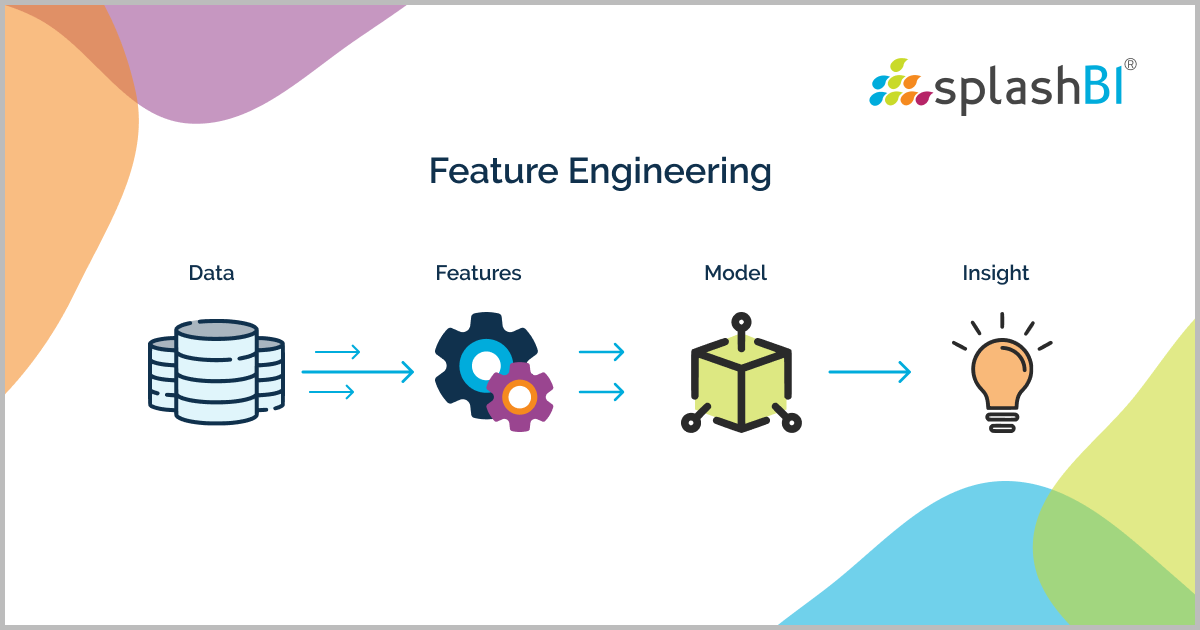
There are Three Main Goals of Feature Engineering:
1. Align Analysis with the Business Problem:
An HR consultant with rich domain experience is aware of the pain-areas of the HR processes & practices and can map the attributes to the business problem. Statistical analysis methods such as correlation heat maps or distribution graphs can help delve into hidden patterns/relationships. Consider the example of metric employee attrition. Customarily, it is analyzed for factors like performance, time in the company, or location/department. What if the domain expert wishes to explore the role of ‘Gender’ on the same? A study at an early stage makes the inclusion/exclusion of a feature comparatively easier. Any modification in the model at the later stage will have a ripple effect and thus, requires additional effort.
2. Eliminates Unnecessary Data:
Analytics has a more significant impact than traditional reporting due to its capability to capture the audience’s attention through eye-catching visuals. However, displaying too much information can confuse the audience and divert their focus away from the essential metrics. Over-loading the analytics model with unnecessary features can decrease the accuracy and negatively affect the model’s efficiency. This is where ‘feature engineering’ comes into play and ensures that attributes relevant to the business problems are the only ones selected and fed into the analytics model. Good feature selection is critical for the correctness of the solution and additionally optimizes the model.
3. Promote Scalability of the Model:
We live in an ever-changing world where situations are constantly evolving. One such example is the ongoing pandemic. COVID19 has affected everyone across the globe at varying degrees and in different aspects, forcing companies/sectors/industries to adapt to the unknowns. Similarly, the analytics model should handle the current process & be flexible enough to adapt to changing business needs. Intelligent feature engineering optimizes the model by selecting only the relevant variables, thereby reducing the effort to retrain a model if new features are added in the future. This improves the scalability and adaptability of the model.
Several feature engineering techniques, such as Imputation, binning, one-hot encoding, etc., will be discussed in detail in the forthcoming article. This article gives an overview of feature engineering and sets the foundation for future discussions. It highlights how feature engineering can isolate critical information from data noise, connect the dots, and highlight patterns to maximize the outcomes from the machine learning models.
Conclusion
Despite being in its nascent stages, feature engineering can reap the utmost benefits from the available data. It addresses both functional & non-functional aspects of a model. Feature engineering is a crucial step in data science. It ensures that relevant, reliable, and accurate data is fed to any predictive model.
Frequently Asked Questions
How does domain knowledge affect feature engineering?
Domain knowledge is critical in feature engineering as it guides the selection, transformation, and creation of variables that carry genuine predictive power, moving beyond purely mathematical feature construction. This expertise identifies causal data points within a business context, informs appropriate transformation techniques, and ensures features are operationally relevant and aligned with established business processes.
How do you choose the right features without adding too many?
To choose the right features for an analytic pipeline without creating "feature bloat," focus on aligning every tool with specific business outcomes and KPIs. Prioritize a platform that offers high customizability and self-service capabilities over fixed, pre-built solutions. This ensures your analytics remain flexible as business needs change, avoiding the complexity and cost of over-built systems.
What are the main goals of feature engineering?
The main goals of feature engineering are to improve machine learning model performance and accuracy, simplify data transformations, create meaningful features, establish effective predictive relationships, and unlock the full potential of the data.
What are the most common feature engineering techniques?
Feature engineering is the process of transforming raw data into features that better represent the underlying problem to predictive models, thereby improving model performance. It's crucial because the quality of your features directly impacts the quality of your model's predictions. By creating more relevant and informative features, you can help machine learning algorithms learn patterns more effectively, leading to more accurate and robust models.
What is feature engineering in machine learning?
Feature engineering is the process of transforming raw data into features that better represent the underlying problem to predictive models. It's crucial for improving model performance by making data more understandable and useful for algorithms to learn patterns effectively. This leads to more accurate and robust predictions. Within SplashBI, concepts like data enrichment and data transformation are integral, preparing and enhancing data for analytical and machine learning applications.
Why is feature engineering important for machine learning models?
Feature engineering is vital for machine learning models because it transforms raw data into meaningful features, directly improving model accuracy, performance, and interpretability. It helps models learn more effectively, generalize better, and extract maximum value from the data.