
If you judged the future of HR solely by vendor marketing, you would think artificial intelligence has already transformed the workplace.
Every conference keynote promises revolution. Every product demo hints at automation. Every software roadmap now seems to carry the same message: AI is no longer coming. It is here.
But at this year’s OHUG Spring Fling, one session cut through the noise with a far less glamorous, and far more honest, assessment of where HR actually stands.
Hosted by SplashBI’s Tom Ericson and Brianne Minnich, the session, “Crawl, Walk, Run, Ask: A Practical Roadmap for Bringing Conversational AI to Your Oracle HCM Data,” offered something rare in today’s AI discourse:
Not hype. Not futurism. Not another breathless prediction about machines replacing managers. Just reality.
And the reality, according to the room, is this:
Most HR teams are nowhere near “AI transformation.” They are still figuring out how to walk.
Click here to watch the full webinar on demand.Everyone Wants AI. Few Know What They Actually Want It For
There is perhaps no phrase more common in enterprise software right now than “We need AI.”
It appears in the boardroom. In budget meetings. In procurement conversations.
But as Ericson explained during the session, the demand for AI often arrives before the strategy behind it. Many organizations now begin vendor conversations insisting AI must be part of the platform.
Yet when asked what they are currently doing with AI, many admit the answer is simple:
Nothing.
That contradiction may define this moment in enterprise HR technology better than any market forecast. Organizations know they are expected to care about AI. They know leadership wants a roadmap. They know competitors are discussing it. But many are still struggling to articulate the business case beyond: because everyone says we should.
It is not resistance. It is uncertainty.
And beneath the pressure to modernize lies a bigger truth: Most HR organizations are still trying to solve more foundational problems first.
At OHUG, the Audience Told the Same Story
During the session, Ericson and Minnich asked attendees to identify where they currently sit in their analytics maturity journey.
The response was immediate and revealing.
Most attendees placed themselves firmly in the crawl or walk stage, not the run stage.
In other words:
- They have reporting.
- They may have dashboards.
- Some are experimenting with analytics.
But few feel they have fully matured into advanced, AI-powered decision-making.
Because outside conference walls, the prevailing narrative often suggests that companies are racing headfirst into sophisticated AI ecosystems. Inside the room, however, the sentiment was much more measured.
As Minnich reassured attendees: “You’re not alone where you are in your journey.”
And perhaps more importantly: “Ultimately, you do have to start at a crawl before you can run.”
The Dirty Secret of Enterprise AI: It Cannot Save Messy Data
For all the excitement surrounding AI, the presenters returned repeatedly to one uncomfortable but necessary point:
Artificial intelligence does not fix broken data.
It does not repair fragmented systems.
It does not clean poor governance.
It does not magically standardize inconsistent reporting logic.
As Ericson put it plainly: “Bad data in, bad data out.”
This may be the single biggest misconception slowing meaningful AI adoption in HR.
Too often, organizations view AI as the solution to their reporting frustrations when in reality, it only magnifies what already exists beneath the surface.
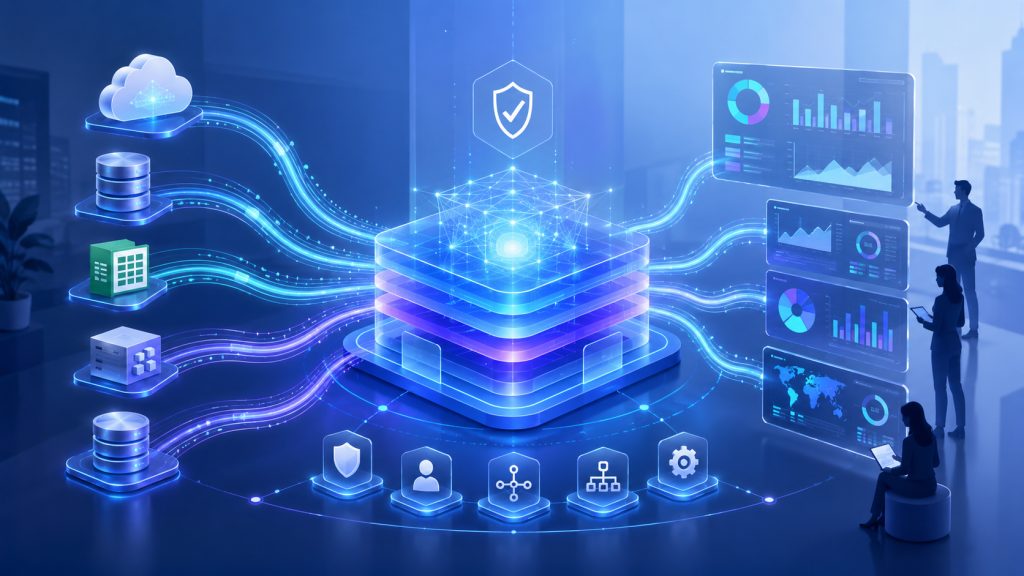
If workforce data is fragmented across Oracle, payroll systems, recruiting platforms, spreadsheets, and custom fields, then AI will not create clarity.
It will simply surface the same inconsistencies faster.
Before AI can become transformative, the presenters argued, organizations need to first build the underlying architecture required to support it:
- Centralized access to data
- Standardized definitions of KPIs
- Governed reporting logic
- Trusted source-of-truth systems
Without those foundations, AI becomes less of an accelerator and more of a risk multiplier.
The Future of AI in HR Is Not Faster Answers. It Is Better Questions.
One of the most compelling moments of the session came when the conversation shifted from data retrieval to data interpretation.
Because while much of the AI discussion today centers around accessibility, natural language search, conversational dashboards, instant answers, the presenters made a more strategic argument: That is only the beginning. The real value of AI is not that it tells you your turnover rate is 15 percent.
The real value is that it helps explain:
- Why turnover is happening
- Where it is concentrated
- What patterns are emerging
- What leaders should do next
As Ericson framed it, simply surfacing a number is not insight. Insight comes from helping leaders understand the story behind the number. And that distinction matters.
Because the future of HR AI may not be about replacing analysts.
It may be about giving HR leaders the ability to move from reactive reporting toward real strategic advisory.

Trust Remains HR’s Greatest Barrier to Adoption
If excitement defined the opening of the conversation, caution defined much of the second half. Throughout the webinar, the speakers repeatedly returned to the same concern they hear from clients:
Trust.
For HR leaders, AI enthusiasm often collides quickly with operational reality.
Can an AI tool safely handle compensation data?
Can it respect role-based permissions?
Can managers trust that confidential information will remain confidential?
Can the outputs be audited?
Can hallucinations be prevented?
Minnich noted that these governance concerns remain one of the most common barriers to adoption when discussing AI in HR environments.
And frankly, they should be. HR data is among the most sensitive data any enterprise owns. That means the organizations that win with AI will not simply be the ones with the flashiest technology. They will be the ones with the strongest controls.
The Smartest HR Teams Are Not Rushing. They Are Preparing
Perhaps the clearest lesson from OHUG Spring Fling is that the future of HR AI will not belong to whoever moves first. It will belong to whoever builds best.
To the organizations that:
- Clean their data before scaling it
- Establish governance before automating it
- Build trust before democratizing it
- Focus on process before platform
Because while the market may reward speed in the short term, enterprise transformation rarely happens through rushing.
It happens through readiness.
And right now, readiness is exactly what many HR teams are still building.
Watch the Full OHUG Spring Fling Session On Demand
If your team is evaluating how to bring AI into HR analytics, or simply trying to understand where your organization fits in the maturity curve, the full OHUG Spring Fling session offers a practical, grounded framework for thinking about what comes next.
Watch Tom Ericson and Brianne Minnich’s full session on demand here.
Click here to watch the full webinar on demand.